
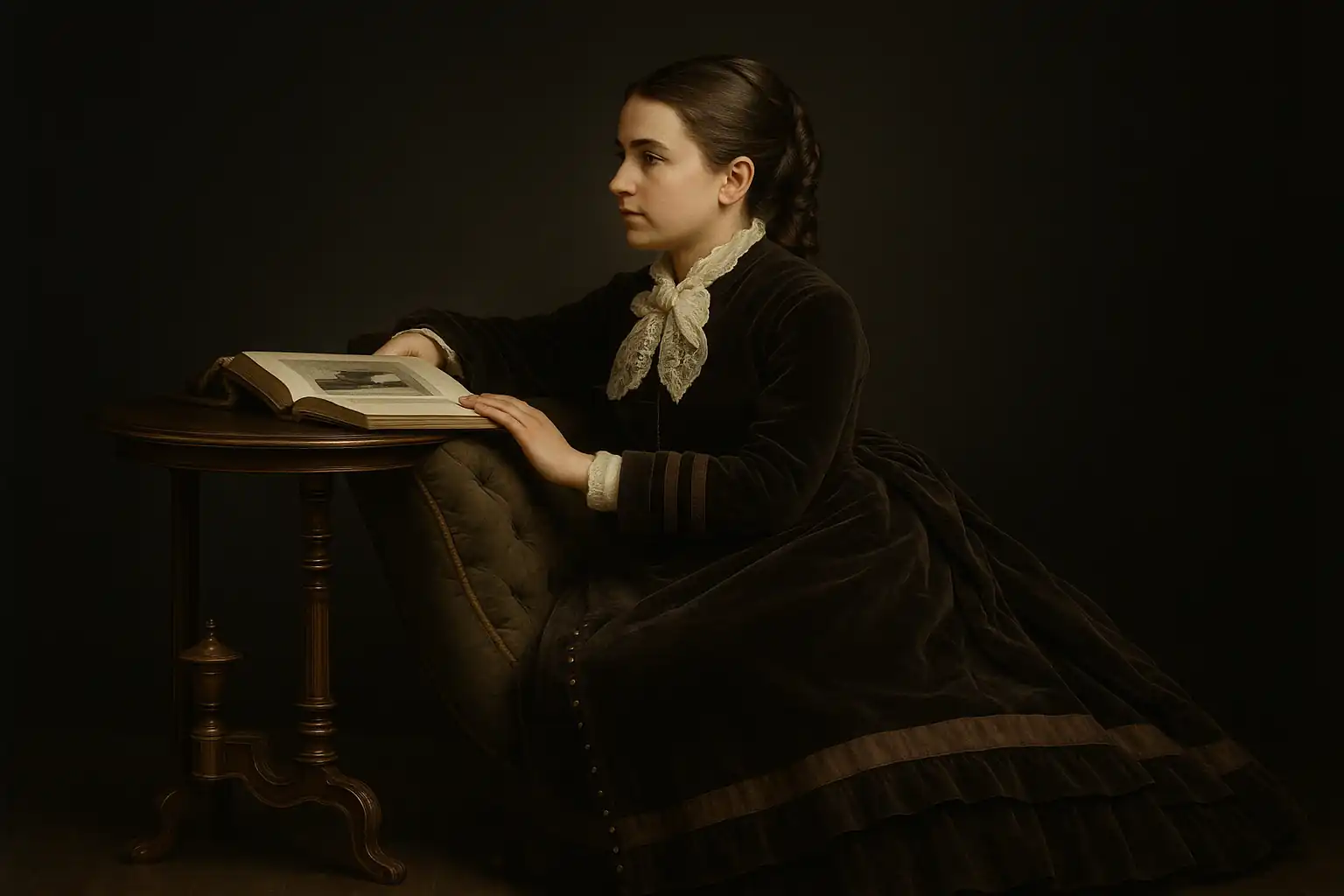
1849 – An Extraordinary Childhood
Born in Moscow into an aristocratic family, Sofia Kovalevskaïa grew up in a world where women were expected to remain silent. Yet from a young age, she showed a deep fascination for science.
Her grandfather, an astronomer, passed on to her a love of mathematics, while her Polish family heritage instilled in her a profound sense of freedom. Barred from Russian universities, she studied on her own, reading lecture notes that her father had used to wallpaper her room — a quiet symbol of determined learning.
1868 – A Marriage for Knowledge
At nineteen, Sofia entered a fictional marriage with Vladimir Kovalevski, a young scientist. The arrangement allowed her to travel to Europe, where she first studied mathematics and physics at Heidelberg, despite official bans on female students.
In 1870, she moved to Berlin to study under Carl Weierstrass, one of the greatest mathematicians of his time. He quickly recognized her talent and became her mentor. In 1874, Sofia defended a groundbreaking thesis on differential equations and earned her doctorate from Göttingen — becoming the first woman in Europe to receive such a title.
1878–1884 – Between Struggle and Recognition
After years of rejection in Russia, Sofia accepts a position at the University of Stockholm — a first for a woman in a European institution.
1889 – Legacy of a Pioneer
Admired for both her intellect and her sensitivity, Sofia became known as “the princess of mathematics.” She also wrote short stories and plays, blending science with poetry.